
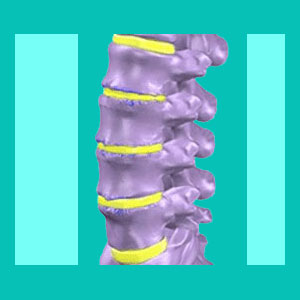
Disc desiccation is another of the many diagnostic terms for disc degeneration, also known as degenerative disc disease. When discs desiccate, they dry out and shrink, losing mass, circumference and diameter. While this process is completely normal and expected in all humans as we age, it has been vilified by the back pain industry and is often implicated as a primary or secondary source of pain in many diagnosed patients.
Desiccation causes the nucleus to lose its ability to rehydrate, so the entire disc structure slowly deteriorates over time. The annulus becomes brittle and may develop small cracks or holes, called annular tears. As the desiccation progresses, the disc may herniate, but this is not inherent or unavoidable.
This essay will investigate why intervertebral discs dry out and the effects this deterioration will have on the spinal anatomy.
What Causes Disc Desiccation?
Disc degeneration is a normal part of getting older. The anatomical aging processes make noticeable and verifiable changes in the vertebral bones and intervertebral discs in every human spine. These processes are typically nothing to be alarmed about and are generally completely asymptomatic. In rare cases, extreme DDD may elicit pain, or even spinal instability, although this is certainly the gross exception to the rule.
I get letters from patients constantly stating that they are surely the exception to the rule, since their doctors have diagnosed them with degenerative disc disease pain. However, upon receipt of their MRI reports, they are certainly not in the minority and in most cases present completely typical spinal profiles, so far without notable exception in tens of thousands of patients over many years.

Universal Truths of Disc Desiccation
Disc degeneration can be seen as a reduction in the size of the intervertebral spaces on an x-ray. However, herniated discs will typically appear exactly the same. An MRI will better diagnose the exact nature and extent of degeneration, as well as provide more detailed insight as to any possible neurological implications of the condition.
Of course, these herniated disc pictures should not be used as exclusive diagnostic tools. Instead, the images should be part of a complete diagnostic process including a thorough physical exam, which is rarely performed, and a clinical neurological correlation to the actual specific symptoms experienced, which is unfortunately almost unheard of.
Desiccated Spinal Discs
I do not know how to make it any more clear. Disc degeneration is not an issue in the vast majority of diagnosed patients. You have it. I have it. Your doctor has it. We all have it. This should not be a surprise to you. Do not write telling me that you saw it on your x-ray or MRI film, since I can tell you it is there without even seeing the film. No one is arguing that DDD does not occur. In fact, it is the opposite. It occurs universally.
The argument comes from the fact that there is little, if any, evidence that DDD is painful or symptomatic in any way. In the tens of thousands of patients I have worked with, the condition has turned out to be harmless, almost without exception, but is sometimes used as a scapegoat to explain otherwise idiopathic symptoms.
Now that you know the facts of disc desiccation, you are well prepared to find lasting relief using our proven Cure Back Pain Forever Program. Help is available for you 24/7 worldwide.
Herniated Disc > Degenerative Disc Disease > Disc Desiccation