
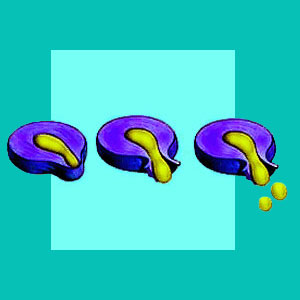
A sequestered herniated disc is a ruptured and extruded disc in which at least part of the interior disc nucleus has been ejected from the structure, detached and subsequently migrated into surrounding tissue. The sequestered fragment is often close by, but in some instances can travel quite far from the original location of the extrusion, especially when trauma is the cause of the rupture. This condition is also called a sequestered extrusion, a sequestered fragment or simply a sequestered disc.
This article will examine some of the lesser known facts about disc sequestrations, including what happens to disc fragments which float freely in the spinal anatomy.
Sequestered Herniated Disc Definition
Sequestrations are the most severe form of disc rupture, but are statistically no more problematic than normal ruptures or extrusions in which the nucleus fragment remains attached to the disc.
There is a slightly higher chance for a chemical radiculitis diagnosis in patients with a fragmented sequestered condition, since the multiple pieces of nucleus protein have a greater chance of affecting surrounding nerve tissue. However, it is crucial to remember that chemical irritation remains a highly debated diagnosis for many patients. Some people just do not seem sensitive to the same interior nucleus protein that is deemed responsible for causing other patients terrible pain.
Intervertebral Sequestration
Sequestered discs can demonstrate a variety of anatomical expressions. Some discs lose one large fragment which often stays bound together in a chunk shape as it moves to wherever it will finally reside. Other discs may demonstrate a variety of smaller fragments which can travel together or in different directions. Some discs involve a smear of nucleus material across a linear path. Finally, a few intervertebral discs seem to virtually erupt, causing a splatter of tiny fragments into the surrounding spinal tissues.

Regardless of the pattern produced by the rupture, the largest fragments are easily found and identified on diagnostic imaging, such as MRI, while tiny bits of disc nucleus are likely to be reabsorbed by the body rather quickly.
It must be mentioned that virtually all disc fragments are likely to be neutralized by the body with time, but the larger the fragment, the longer this process might take. Some fragments may calcify into small solid pieces which resemble bone, rather than being absorbed by the surrounding organic tissue. This occurrence can contribute to various types of central spinal stenosis and/or neuroforaminal stenosis.
Sequestered Herniated Disc Care
Many orthopedic surgeons make lots of money removing sequestered fragments from patients whose pain has been blamed on a disc rupture. However, the statistics for full resolution of pain via surgery are not promising for most conditions.
In the case of chemical radiculitis diagnoses, epidural injections show better curative results than surgery and are far less invasive. These injections can speed up the re-absorption of irritating proteins and can flush away these chemicals from sensitive nerve structures.
Herniated disc surgery may only be a better bet with the largest of fragments and those which are definitively causing a verified nerve compression or spinal cord compression issue. For patients with diagnosed pinched nerves or central spinal stenosis conditions from a sequestered fragment, I strongly urge you to consult with a spinal neurologist before pursuing any treatment. While it is possible for these fragments to enact pain and dysfunction in some instances, it is not at all likely. After all, the fragments are not pressurized and can not exert force against any neurological tissue, unless they become lodged against another more durable structure, such as a vertebral bone or a hypertrophic ligament. These scenarios represent an extreme minority of cases.
Herniated Disc > What is a Herniated Disc > Sequestered Herniated Disc