
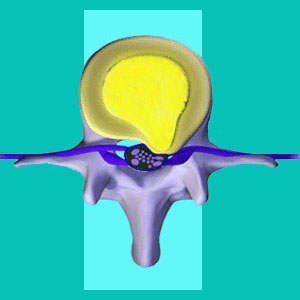
The nucleus pulposus is the moisture-rich inner core of an intervertebral disc. This soft center is composed mostly of water, collagen and polysaccharide gel. The moisture content of the nucleus provides the disc with the majority of its mass, as well as its height and diameter. The disc nucleus is surrounded and contained by the many tough fibrous layers of the annulus fibrosus.
This article will provide anatomical detail on the nucleus of a typical spinal disc. We will also investigate the changes which occur due to degeneration and injury when a disc deteriorates or herniates.
Disc Nucleus Hydration Cycle
Young, healthy discs are fully hydrated and optimized in their moisture retaining qualities. Disc hydration changes constantly, with the most moisture existing early in the day, after a good nights rest.
As activity and pressure are applied to the spine throughout the day, the disc loses moisture. This loss of hydration causes the spinal discs to shrink as the day wears on, actually making the person slightly shorter at the end of the day compared to the beginning.
Once pressure is removed from the spine through the reclining position of sleep, the discs will rehydrate again and the entire process will begin anew.

However, as time passes, discs progressively lose the ability to fully rehydrate. This process is called desiccation. While the drying out of the disc does enact structural changes, it is not considered inherently painful or pathological in any way.
Nucleus Pulposus Degeneration
The disc nucleus begins to deteriorate at some point in its life. These degenerative changes are usually first noticed in the lumbar area, followed by the cervical spinal region. Most adults experience noticeable mild to moderate disc degeneration by the age of 30 and many people experience these changes even younger.
Typically, the thoracic discs do not undergo such drastic degeneration, since the middle spine does not endure the same constant vertebral segment movement and loading as the lumbar and cervical regions. In essence, the upper and lower parts of the spine must bend and flex far more often and to greater degrees than the mid back.
The disc nucleus slowly loses its water retaining ability with time. This makes the disc lose mass, height, diameter and circumference. Many doctors call this condition degenerative disc disease, although the name is deceiving. This is certainly not a disease process at all, but simply a normal and expected part of the disc’s lifespan.
Eventually, most spinal discs will shrink considerably as the aging process progresses. This is the reason why we get shorter as we get older. These degenerative changes also dry out the annulus fibrosus, facilitating mostly asymptomatic versions of intervertebral herniation.

Nucleus Pulposus Considerations
Remember, age-related disc changes are normal. If you are diagnosed with degenerated discs in your spine, make sure to understand that you are no different than any other human on this planet. Extreme disc degeneration can cause problems for a very small percentage of patients, but is typically nothing to be concerned about.
Bulging discs are also very common, especially in the lumbar and cervical spinal regions. Most disc herniations are completely asymptomatic and many patients will not even know they have a disc prolapse.
Herniations which occur spontaneously due to trauma will sometimes cause severe acute pain. However, it is rare for herniated discs to cause the chronic unresolved symptoms often experienced by many back pain patients, unless they are studied and shown to produce definitive nerve interactions, such as compression or chemical irritation.