The spinal disc anatomy is well designed to impart numerous structural and functional benefits to the human backbone. The vertebral column is a wonder of evolution and allows humans to perform a wide range of functions and activities, while still providing amazing support and structure to our physical bodies.
This discussion will focus on the actual intervertebral disc function within the spine, as well as how discs are implicated in causing pain and neurological impairment due to various processes, including traumatic injury and normal age-related degeneration.
Spinal Disc Anatomy Factsheet
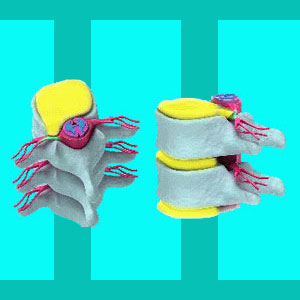
Spinal discs are soft tissues found between each vertebral bone in the spinal column. The vertebrae provide structure, support and strength, while the discs provide flexibility and cushioning.
The individual vertebrae are separated by the intervertebral discs, which help to elongate the spine and provide shock absorption qualities between the vertebral bones.
When added together, the discs make up approximately one quarter of the total length of the spinal column. although this combined height diminishes as we get older and the discs begin to dehydrate.

Intervertebral Disc Anatomy and Functionality
The discs help to insulate the spine from shock. The spine is a curved vertical column which is subject to the effects of gravity, compounded by the weight of the body. Additionally, the forces applied to the spine, due to our various physical activities, are substantial. The discs help to absorb and distribute these forces, helping to prevent injury and making life far more comfortable.
The intervertebral discs also create movement in the spinal column, facilitating the vast range of motion we enjoy.
As previously mentioned, when our spines age, the discs shrink due to water loss, making us slightly shorter and less flexible. The feeling of stiffness which accompanies advancing age is not just a perception; it is a actual characteristic of the aging process for the backbone.
Spinal Disc Anatomy Understood
The intervertebral discs are perhaps the greatest back pain scapegoat in the medical industry. Discs are blamed for causing a wide range of problematic conditions, although most of these theories are simply not correct. While discs can and do suffer injury and degeneration, they are rarely the cause of serious or lasting pain conditions. This truth has been substantiated in countess research studies which do not correlate the existence of disc abnormalities to the expression of back or neck pain.
Learning the facts about herniated discs is an important part of recovering from a diagnosed disc pain syndrome. Always remember, many people have back, neck or sciatica pain, but have no herniated discs at all.
Many people have pain and coincidentally also have herniated discs.
Many people have herniated discs, but no pain.
Of course, in some instances, a disc can be the actual cause of verified symptoms, when true nerve compression takes place. However, with inconclusive statistics like these, it is hard to imagine how the poor maligned disc has acquired such as bad reputation in the past 70 years.