
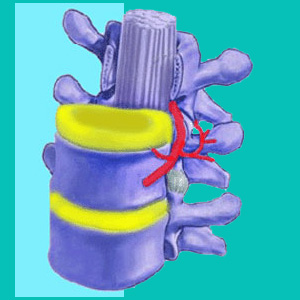
A bulging disc is the most common form of herniated disc. Typically, a healthy disc is generally symmetrical. When a bulge occurs, it creates an distended appearance due to uneven pressure being placed against one side of the outer disc wall. Disc bulges can occur for many reasons and are considered the most common of all spinal abnormalities, especially in the lower lumbar and cervical regions. In all cases, bulges will occur in discs which are intact. Once the outer annulus fibrosus is compromised, the condition is considered a rupture, extrusion or sequestration and is no longer a simple bulge.
This resource section provides an objective examination of intervertebral bulging in the human spinal column.
Bulging Disc Condition
The annulus fibrosus is very strong and surrounds the softer, moister nucleus pulposus. This nucleus does not have much form on its own and has a tendency of morphing its shape to fit the container in which it is placed. Of course, its natural container is the annulus fibrosus, so when the outer disc wall develops a bulge, the nucleus will push into that space, filling it and applying additional pressure.
Being that the disc is a natural shock absorber, it is normal for the nucleus to move about and exert force on the annulus. When the annulus is compromised, a bulge will occur. If the integrity of the outer annulus is broken, then the nucleus might actually bleed out of the disc structure, called a rupture.
Disc herniations are very individualized events, with the specific circumstances of each creating unique case profiles. In some instances, the outer disc wall might become damaged or weakened first, leading to a hollow space to form. This bulge or bubble is quickly filled by the nucleus material. In other cases, extreme force of the nucleus might cause the annulus fibrosus to buckle, creating the herniation due to direct internal force on the outer disc wall. Regardless, the term bulging disc describes a slight or significant bubble in the annulus, but not a condition in which the nucleus has actually ruptured out of the disc structure.

Intervertebral Bulge Topics
Below, we are provided several topical reports covering the most important points of intervertebral bulging:
Bulging disc symptoms range from none to severe. There is no such thing as a typical bulging intervertebral disc.
Diagnosis of bulging spinal discs can not be performed without the benefit of advanced diagnostic imaging, such as magnetic resonance or CT scan.
Lumbar bulging spinal discs represent the most common variety of intervertebral protrusion. However, cervical bulging intervertebral discs are not far behind. Thoracic disc bulges are the least common, but can be troublesome for some patients.
While bulging intervertebral structures might appear to be swollen, they are certainly not suffering from spinal disc inflammation in a traditional sense.
Bulging Disc Terminology
Many doctors make a differentiation between a disc bulge and a disc herniation. In reality, there is absolutely no difference and the terms are used interchangeably by most care providers.
For doctors who do make a distinction, a bulging disc is generally used to describe a less serious herniation, in which the integrity of the disc remains with only minor change in overall shape. The term herniation is used to describe a more pronounced bulge, in which the disc integrity might be suspect and there may be a deformed contained pocket of nucleus tissue or an annular tear present.
All these variations of terminology, including bulging disc, herniated disc, ruptured disc, slipped disc, prolapsed disc, collapsed disc and disc protrusion, create nothing but confusion for many diagnosed patients.
If you have been diagnosed with any of these terms, make sure to understand the scope and prognosis offered by the doctor. Ask questions until you completely understand the condition which is being described to you. After all, there is nothing more perplexing than having 3 individual doctors each calling the same disc condition by a 3 different names and worse yet, describing 3 completely different possible symptomologies. This is unfortunately very common in the herniated disc industry.

Spinal Disc Bulge
Intervertebral discs might bulge during normal day to day activities. It is expected for discs to change shape and size according to moisture content and stressors placed upon the spine. However, these bulges are momentary and will not affect the structural strength of the disc.
When you are diagnosed with a bulging disc, this means that the herniation exists, regardless of whether stress is being placed on the spine or not. In essence, the bulge remains even when the spine is relaxed and not bearing weight. If you have been diagnosed with a bulging disc, do not fear. This condition is so common that you are among the vast majority of the adult population in experiencing this typically non-problematic spinal alteration. Most bulges will not cause pain now or ever.
Symptomatic bulges will usually resolve without any special medical attention. It is rather ironic that patients try so many bulging disc therapies, when in reality, only a small percentage of problematic disc bulges will require drastic treatment or surgery.
Need immediate help for a bulging disc? Our proven Cure Back Pain Forever Program is here to help you 24 hours a day.