
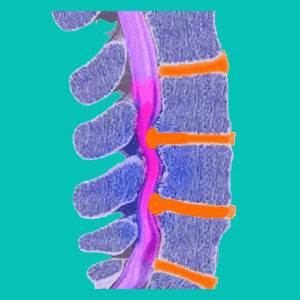
A herniated disc compressing the spinal cord is one often most serious of all diagnostic conclusions associated with intervertebral abnormalities and is certainly cause for alarm. The spinal cord is the main conduit of life energy throughout the body and any structure which compresses it can create the ideal circumstances for widespread and potentially dire neurological impairment to occur.
That being said, there are many cases in which a disc is merely touching or slightly displacing the spinal cord, which are not inherently symptomatic conditions.
This article will help differentiate diagnoses which are virtually inherently symptomatic from those which are typically innocent when it comes to spinal cord and spinal nerve contact.
Herniated Disc Compressing the Spinal Cord Facts
Spinal cord compression describes a condition in which force is being applied directly into the cord by a bulging or ruptured disc. This herniation will usually be large in order to compress the cord sufficiently to warrant the diagnosis. In some cases, the disc is only partially to blame for compression, since normal degenerative changes in the spinal canal may include the formation of osteophytes, osteochondral bars or ligament inflammation, which may enact the complete compressive condition.
Compression entails that the cord is being squeezed and is not merely contacted by the herniation or crowded by the herniation. More common and typically less serious diagnostic wordings may include:

Herniated disc encroaching on the spinal cord.
Possible cord impingement by a herniated disc.
Herniated disc providing a mild mass effect to the spinal cord.
Spinal cord displacement by a bulging disc.
Herniated Disc Compressing the Spinal Cord Details
The spinal canal has enough room for all the neurological structures and cerebral spinal fluid to be safely protected. However, when an arthritic process, ligamentous hypertrophy or intervertebral herniation takes up some of the space inside the canal, possible symptoms may result.
Most cases of disc-related spinal stenosis conditions occur due to central herniated discs or large posterolateral herniated discs.
When the spinal cord is actually compressed, neurological dysfunction is the usual result and may cause serious health issues ranging from limited mobility, to the bowel and bladder issues associated with cauda equina syndrome, to paralysis, or even death, if the compression is severe and occurs in the upper cervical spine.

Bulging Disc Compressing the Spinal Cord
There is absolutely no doubt that any issue which affects or possibly affects the spinal cord is worth monitoring, at the very least. I have a rather frightening looking cervical herniated disc which is displacing my spinal cord significantly in the lower neck region. I must admit that this condition is a source of worry for me and my doctors, as well.
Remember, compression is the most serious condition, but impingement, displacing or simply touching are not necessarily truly problematic. In some cases, these conditions may create some symptoms, while in others they are mostly or completely asymptomatic.
However, it is a known fact and proven statistic that patients with arthritic or disc issues which efface or contact the cord in any way demonstrate a greater risk for serious spinal cord injury, or even paralysis, if they suffer considerable trauma, such as a car accident or bad fall.
Herniated Disc > Herniated Disc Diagnosis > Herniated Disc Compressing the Spinal Cord