
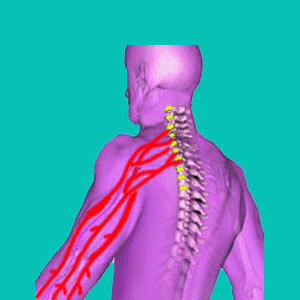
A pinched nerve can be caused by a multitude of possible disc-related scenarios. Compressive neuropathies are the most commonly cited reason why herniated discs might enact pain. It is crucial to remember that spinal discs do not have any internal nerves of their own, so they can only cause pain when they affect a nearby nerve structure. Additionally, structural compression is the most common reason for these disc-induced neuralgias to occur, followed by the far less likely occurrence of chemical irritation.
This discussion will center on compressed nerve structures which may or may not be caused by bulging discs. We will focus on foraminal stenosis as the most common source process of nerve impingement.
[contentblock id=1]
Pinched Nerve Explanation
Nerves which are compressed, impinged upon or constricted are said to be “pinched”. This nomenclature is typically used to describe nerve root compressions in the middle back, upper back and neck. Nerve compression in the lower back is usually referred to as sciatica, but this is not correct, since sciatica is a symptom-set, not a diagnosis unto itself. A compressed nerve can lead to sciatica expressions, directly or indirectly.
Nerves which are pinched might not signal properly, causing a variety of uncomfortable symptoms. Most nerve compression profiles are acute and come on suddenly from some form of trauma to the affected region. Nerve compression is not typically a chronically painful complaint in most patients, since ongoing impingement should cause total numbness and weakness with the passage of time.
[contentblock id=16]
Nerve Compression Symptoms
Acute neurological compression usually entails pain in the immediate area and radiating or shooting pain in the area served by the affected nerve. Continuing compression will usually involve diminishing pain to be replaced by the neurological expressions listed below.
Tingling, numbness and weakness are other common symptoms and these can present themselves in some strange and unique profiles. Tightness and a limited range of motion are other normal symptoms and might affect the muscles in a large surrounding area.
Most disc-related nerve compression syndromes will last a few days to a few weeks and then resolve on their own. Very few require treatment and even those which do necessitate medical care are often easily resolved with something as simple as a single chiropractic adjustment.
Read more about a pinched nerve from a herniated disc.
Causes of Compressed Nerves
The most common causes of minor neurological dysfunction include regional oxygen deprivation, significant vertebral subluxations or muscular tightness actually clamping down on a peripheral nerve. More serious spinal nerve root compression can be caused by a number of congenital or developmental conditions including, spinal arthritis, spondylolisthesis and scoliosis, through the process of foraminal stenosis.
Herniated discs which cause nerve compression usually do so by bulging considerably against the neuroforaminal openings, interfering with nerve signal activity as the nerve root exits the spinal column. These events can be acutely painful for a time, but will usually resolve in 2 to 8 weeks, even without any special care. Many herniations will shrink without therapy, alleviating most symptoms in a short time frame.
For patients with long-term chronic confirmed nerve pain from a herniated disc, one of the better treatment options is spinal decompression. This noninvasive treatment offers excellent curative results without the risks or complications associated with herniated disc surgery.
[contentblock id=11]
Pinched Nerve Facts
Many patients have degenerated and/or herniated discs in their spines which are not causing any pain. These conditions are often targeted as the potential source of symptoms in patients who seem to demonstrate the usual pattern of a pinched nerve, even if structural compression is not verified.
Most sudden nerve pain conditions are the result of either regional ischemia or an insignificant muscular or vertebral issue. Patients who endured some considerable trauma are most likely suffering from the latter, while others may be suffering from the former.
Even low levels of oxygen deprivation affect ultra-sensitive nerve tissue horribly, enacting a powerful symptomatic reaction. Knowledge therapy is the best approach for this type of pain, since physical modalities do not address the root psychoemotional causes of the process.
Patients who experience chronic spinal nerve root pain due to a confirmed herniated disc or arthritic process should try everything to treat the condition non-surgically. If all the conservative options fail, then it might be time to consider a minimally invasive procedure which can enlarge the foraminal opening. Full open spinal surgeries should be avoided at all costs.
[contentblock id=2]