What is a herniated disc? This is the most important question on the minds of millions of back pain patients who are diagnosed with problematic disc issues every year. We have all heard horror stories about disc herniations, but most of us are simply not quite sure what a herniated disc really is.
This resource section will help answer the question once and for all, providing factual information about the nature of disc pathologies. We will also discuss the various types of herniations which can occur and what each means to the diagnosed patient.
What is a Herniated Disc? / Anatomy
Spinal discs are the shock absorbers of the human spine. Together, they make up approximately one quarter of the spine’s total length. Discs allow the great range of motion and flexibility that we enjoy during our lifetimes.
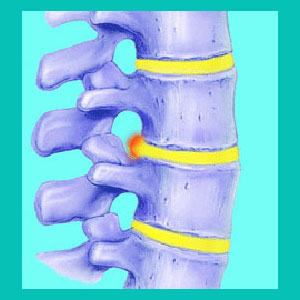
An intervertebral disc is composed of 2 components. The tough outer wall is called the annulus fibrosus and is made up of woven layers of specialized cells. The softer inner core of the disc is called the nucleus pulposus and is responsible for providing flexibility and mass for the disc structure.
A disc herniation occurs when the outer wall of the disc is compromised and the inner nucleus bulges outwards, creating a defect in the disc structure. Below are listed all the articles related to the diversity of possible disc pathologies.

Herniated Disc Discussions
The following dialogs provide comprehensive answers to many disc herniation questions. In order to fully understand the nature of intervertebral herniations, please read the relevant essays below:
Herniated disk is a spelling permutation that often confuses diagnosed patients.
Contained herniated discs remain structurally sound, despite suffering a bulging annulus. No nucleus matter has escaped.
Annular tears describe holes in the outer disc wall, called the annulus fibrosus.
Extruded discs are defined as ruptured intervertebral spacers where the nucleus has already exited the interior of the disc. Meanwhile, a sequestered disc goes one step further in that the nucleus detaches and migrates from the main disc structure.
A sequestered herniated disc and a fragmented herniated disc are very similar, but the ejected nucleus of a fragmented spacer usually has broken into many tiny pieces.
Disc protrusion is another common name for intervertebral herniation, usually describing a significant bulge.
Central herniated discs bulge into the middle of the spinal canal, potentially causing spinal stenosis. These occurrences are also commonly known as median herniated discs.
Posterolateral herniated discs bulge to one side or the other, unilaterally and asymmetrically. These are also called paramedial herniated discs.
Focal herniated discs describe small areas of herniation, while diffuse disc bulge denotes larger areas of bulging tissue. Diffuse bulges are also known as broad based herniated discs.
Anterior herniated discs bulge towards the front of the body, away from the spinal canal, making them almost universally harmless and asymptomatic.
Foraminal herniated discs can enter the neuroforaminal spaces, potentially compressing a nerve.
Extraforaminal herniated discs, also known as far lateral herniated discs, can affect a nerve root after it has already exited the vertebral canal.
Disc calcification occurs when the normally soft disc tissue becomes ossified, creating a hard, bony structure.

You can learn even more about what herniated discs truly are and what they are not at the detailed disc pain section at Cure-Back-Pain.Org.
What is a Herniated Disc? / Variations
Herniated disc is a term which describes a variety of possible structural changes affecting a spinal disc structure. Most often, the nucleus pushes against one specific area of the outer disc wall, causing it to protrude outwards slightly. This is usually called a bulging disc. The integrity of the annulus fibrosus remains intact, but the shape of the disc becomes slightly asymmetrical due to the bulge.
A true herniation is when a considerable portion of the nucleus pulposus pushes into a pocket created in the outer disc wall. This creates a far more noticeable defect in the disc and a greater degree of asymmetry.
Sometimes, the outer disc wall actually breaks open, spilling the jelly like contents of the nucleus into the body cavity. This is called a ruptured disc.
The name herniated disc can be used to describe all of these conditions, as can other common terminologies, such as slipped disc, collapsed disc and prolapsed disc.
What a Herniated Disc Is and Isn’t
Disc herniation is a term which merely describes a physical distention. It does not describe a condition which is inherently painful or problematic in any way. Spinal discs endure universal and completely expected degenerative changes as part of their aging process.

The overwhelming majority of patients experience these mild to moderate changes in the lumbar and cervical spinal regions by the age of 30. Many experience these changes by the age of 20. I already had moderate degenerative changes in my lumbar spine by the age of 16.
Herniated discs can cause neurological problems and pain, when they affect a nerve structure. However, most disc conditions are completely benign and might go completely unnoticed simply because they do not create any significant symptoms. Even painful disc conditions will typically resolve on their own and usually do not require any specialized herniated disc treatment.
To summarize this “What is a herniated disc?” article, herniated discs are basically a normal part of the lives of some lumbar and cervical spinal discs. Discs will inevitably dry out, lose height and bulge as they age. The condition does not mean that the spine will suffer any ill effects, nor does it mean that the patient will suffer any lasting pain.
You can find relief from back or neck pain using our proven program. You can get help 24 hours a day using our proprietary Cure Back Pain Forever Program from anywhere in the world.